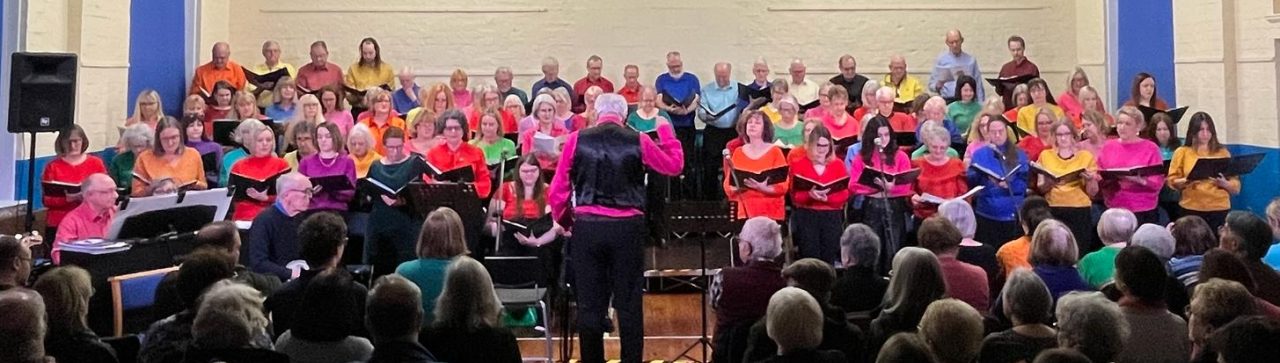
Ian Thompson, from our bass section, shares this account of our recent 3 sell-out performances.
Joseph and the Amazing Technicolour Dreamcoat is a retelling of the biblical story of Joseph (found in Genesis chapters 39-50) in which Lloyd Webber and Tim Rice humorously blended a number of pop-music styles. This was their first musical, first performed on the West End Stage on 1 March 1968. It has a moral tale to tell about loyalty and forgiveness. It follows the story of Joseph who was the youngest of Jacob’s 12 sons. Joseph was Jacob’s favourite and his father loved him more than any of his other eleven sons and gave him a coloured cloak. Inevitably, this aroused jealousy among his brothers who sold him into slavery. The guilty brothers then painted goat’s blood on Joseph’s coat and showed it to Jacob, leading him to believe that Joseph had died. Instead, Joseph had been sold, was taken to Egypt and ended up imprisoned by an Egyptian noble named Potiphar, one of the Pharaoh’s officials, although he eventually became Potiphar’s chief steward and overseer of his granaries through hard work and honest dealing.
The story revolves around Joseph being able to interpret the dreams experienced by others.
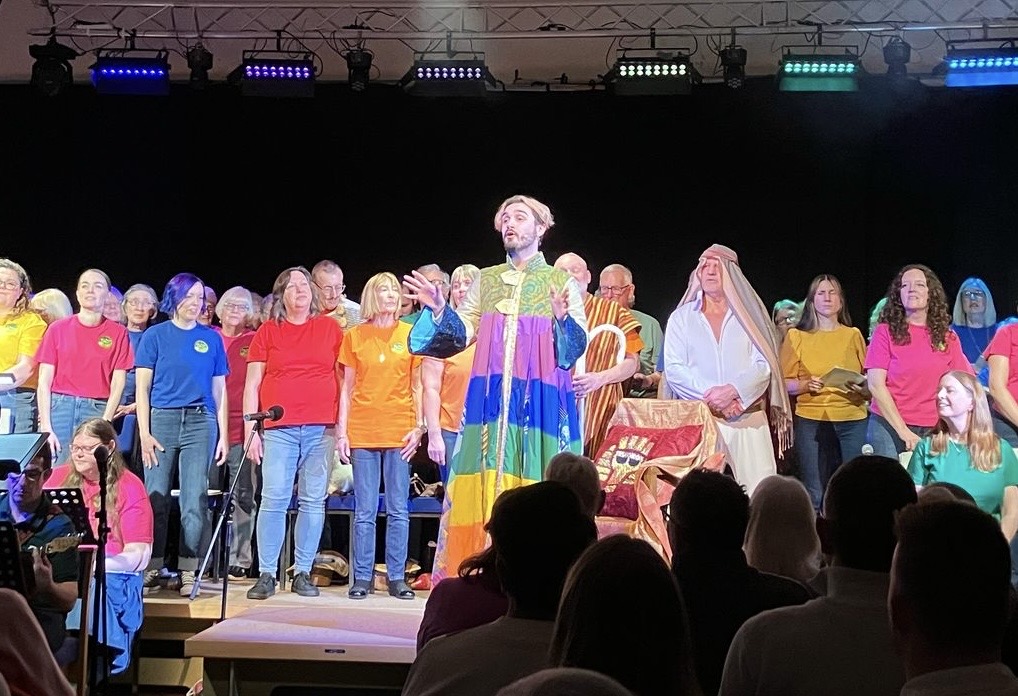
We’re not quite sure what our Director of Music uses to draw new members into his musical net, but we have some excellent soloists and musicians in our midst who combine together to produce some wonderful concerts. On this occasion our concert was in the very capable hands of Helen Taylor as conductor.
Act 1 opened with an overture played by the accompanying band which was then followed by a prologue sung by Sophie Cardwell, the first of several narrators. The opening chorus introduces Michael Needle, a newcomer to EBM, playing a persuasive Joseph, and his brothers who form the male chorus, followed by Jacob, played by another talented newcomer, Roy Leighton, who identifies Joseph as his favourite son by giving him a symbolic, coloured coat. The enmity this aroused amongst the brothers leads into Poor, Poor Joseph which results in Joseph being sold as a slave to a group of Israelites on their way to Egypt. The brothers cover their deed by telling their father that Joseph has been savaged by a goat and has died, while singing in a rollicking Country and Western style One More Angel in Heaven.
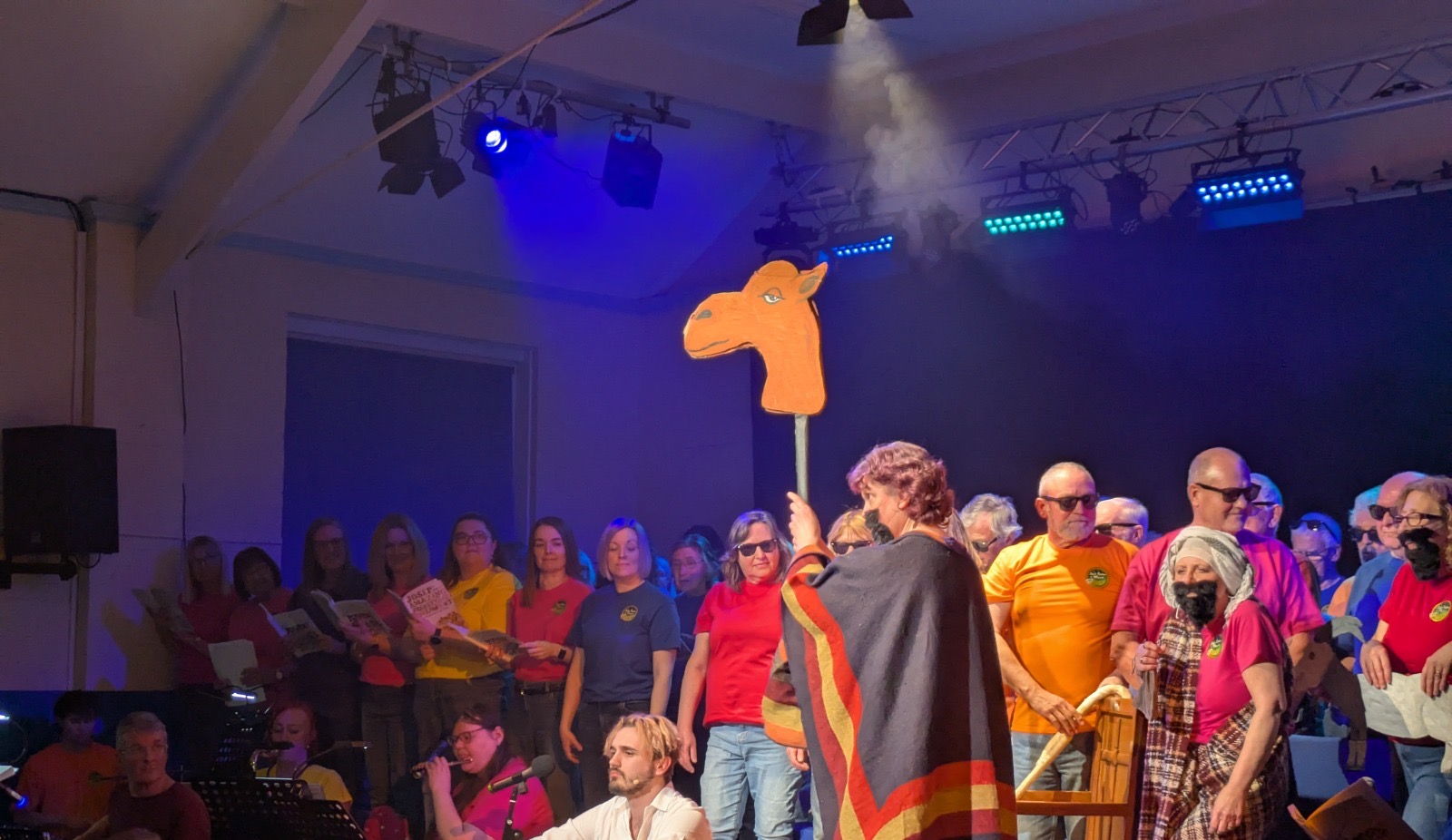
Joseph was taken to Egypt in chains and as a slave and sold to Potiphar, our own Jonathan Thompson. His character was charmingly described by Esther Flanagan and Hannah Pocock, in Twenties style of singing complete with appropriate movements. Mrs. Potiphar, played by Pat Chacksfield, is another kettle of fish, however, portraying herself as a modern Jezebel with a liking for you-know-what only to be emphatically reproached by Joseph with:” I don’t believe in free love.” Potiphar assumes that his wife and Joseph are to be found in flagrante delicto which, although it’s a false accusation, results in Joseph being arrested and thrown into jail.
Joseph accepts his fate as a prisoner singing Close Every Door in which he seeks to find his own peace of mind. Act 1 closed with Daria and Konstantin Naumenko reflecting on Joseph’s plight in the opening part of Go, Go, Joseph which introduces the audience to two of Joseph’s fellow inmates. The two very frightened prisoners, formerly servants of the Pharaoh as a baker and a butler (Cathy Kennedy and Saryu Thakrar), couldn’t understand the dreams they’d been having. Now Joseph had gained a reputation while in jail as someone who could interpret dreams and was asked by the butler and cook to interpret their dreams.
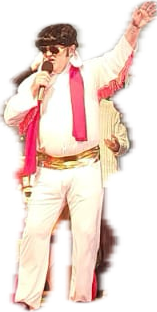
Act 2 opened with Pharaoh’s Story with two narrators, Lin Bastick and Alaina West, reporting that the Pharaoh had also been having strange dreams so Joseph was summoned to his presence. The Pharaoh, in the form of Steve Watkins, suitably attired as Elvis Presley, arrived in Rock-and-Roll style singing the Song of the King. In good old Presley fashion, he wowed the girls in the choir with his characteristic “Uh, huh.” Joseph foresaw in the Pharaoh’s dreams a period of plenty in Egypt followed by famine. Pharaoh, suitably impressed, instructed Joseph to be unchained and gave him a royal pardon and an elevated status as his Number Two.
As such he prepared Egypt well for the forthcoming famine and enhanced Pharaoh’s reputation as a life-saver, especially among his adoring cohort of altos and sopranos (Catherine Waite, Alison Savage, Rachel Smith and Amy Bedster joined the female soloists).
At this stage, many years had passed since Joseph had last seen his family, especially his brothers who, by a lucky chance, were on their way to Egypt to see if they could find food before they starved to death. They reminisced of times past in Those Canaan Days, led by a moustachioed Simon Elvin singing in a heavily accented Charles Trenet way, without recognising their brother Joseph. When he did eventually reveal himself, it was a case of Grovel, Grovel by the now much slimmer brothers. As a test, Joseph planted a golden cup in the bag of young Benjamin then accused all his brothers of having a thief amongst them, an accusation that they strenuously denied in Who’s the Thief followed by the Benjamin Calypso led by Konstantin.
When he heard that his son wasn’t dead after all Jacob went to Egypt to be reconciled with Joseph, taking with him a splendid coat, truly of a breathtaking multitude of many colours. (A special mention is needed for Pat Hall who supplied the amazing multicoloured coat.) The female chorus narrated this in song with Jacob in Egypt. Act 2 closed with Joseph singing Any Dream Will Do, a song made famous by the many West End leads who include Jason Donovan, Donny Osmand, who filled the role over 2000 times, and Philip Schofield.
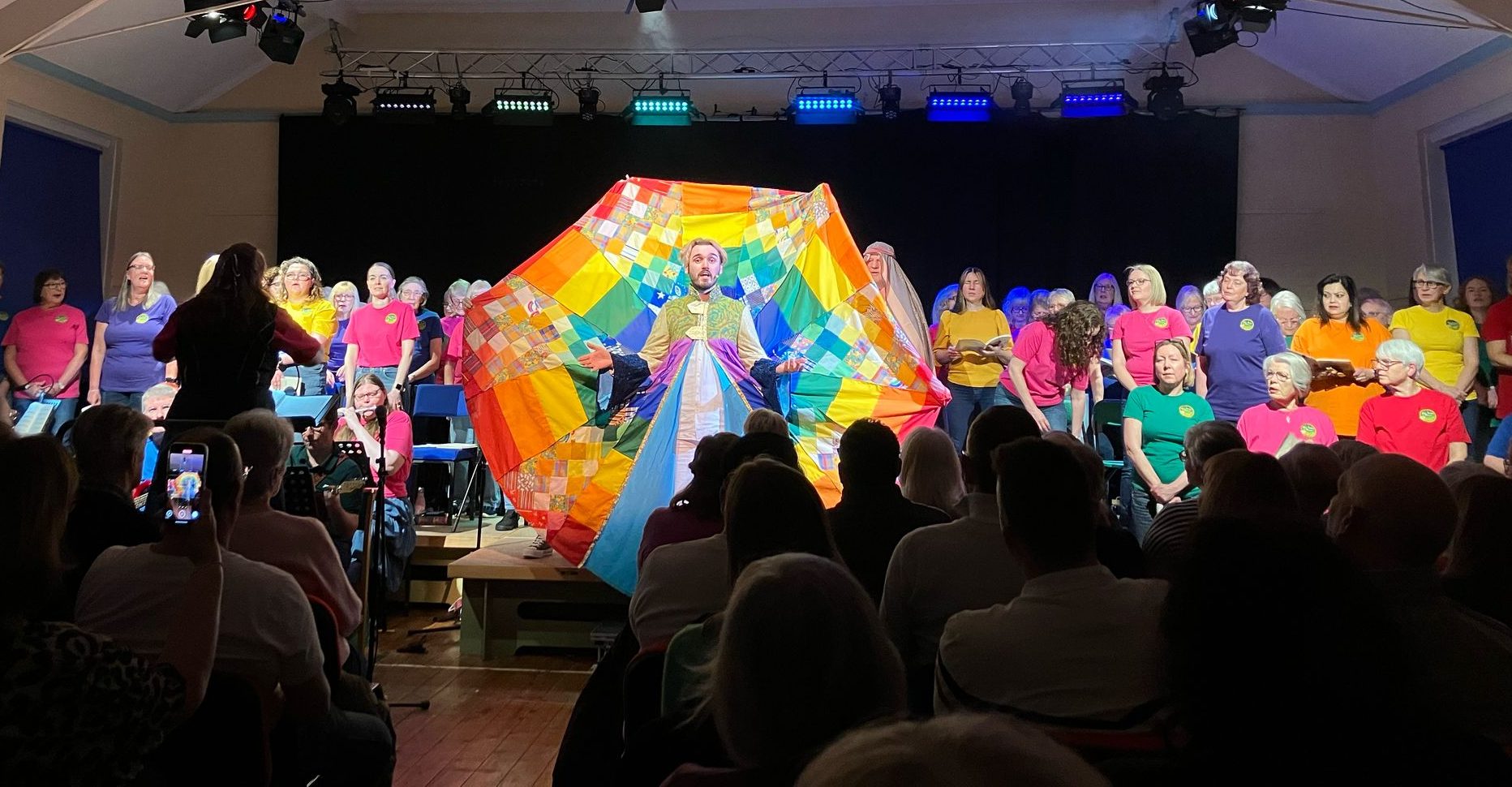
In conclusion, a reprise of seven excerpts was sung with enthusiastic participation of the audience.
 Earls Barton Music